Showing posts with label Sport. Show all posts

Tuesday, 19 July 2011

The Best callaway-diablo-irons33 Reviews

Golf Ball CupcakesImage by tawest64 via FlickrEventually as you increase in the game you can progressively acquire other equipment and a person that you will need to look at is a Callaway Diablo edge driver.

A Callaway Diablo edge driver permits an amateur golfer to hit the ball effortlessly. Its shape has a slightly narrow encounter that affects the aerodynamics positively. It cuts down at least 10% of the drag which can sluggish the club head swings. Hence even beginners can generate quicker club heads resulting to longer drives.

There are other clubs other than the driver that you need to glimpse into. You will need these several clubs dependent on the conditions. For long distance fairway or a tee shot, you would will need woods. When you want 1 to use on the green or to place the ball into the cup, putters is the reply. For other shots you would require irons.

Clubs differ in their lofts, the angle in the middle of the vertical plane and the club's face. The ascending trajectory of the ball is a end result of the loft and not the angle of the swing. Consequently you also have to imagine about the loft on top rated of the style of clubs you are taking into consideration.

As you go to the suppliers to purchase the driver you would also uncover numerous golf balls for sale and you may also wonder which one need to you pick. There are also distinctive golf balls that you can decide on from but there are in essence two classes: recreational and advanced balls. Recreational balls are for the common golfers who have slow swing speeds and who has a terrific probability of losing the ball in the course. Recreational balls are cheap so it would be alright to reduce some along the way. On the other hand, sophisticated balls are for the advance gamers. It is composed of multiple layers that consists of a soft cover and a thin core.

Playing golf seems straightforward specially when you see the pros do it. For people who are interested to play golf, most would just go to the retailer and buy the devices they ordinarily see on Tv without actually figuring out what these objects are for and how to use it appropriately. It would assistance you if you seek out help from an skilled when it arrives to the objects you have to have to receive. He may well have to evaluate your grip and other elements ahead of he can advocate the proper equipment. Sooner or later as you improve in the game you can gradually obtain other tools and a single that you ought to contemplate is a Callaway Diablo edge driver.

A Callaway Diablo edge driver lets an amateur golfer to hit the ball easily. Its form has a somewhat narrow confront that has an effect on the aerodynamics positively. It cuts down at least ten% of the drag which can slow the club head swings. Hence even beginners can generate more quickly club heads resulting to extended drives.

There are other clubs other than the driver that you need to look into. You will require these a variety of clubs based on the situations. For lengthy distance fairway or a tee shot, you would will need woods. When you need one particular to use on the green or to put the ball into the cup, putters is the answer.

Wednesday, 13 July 2011

CCTV shows youth beaten to death in Coimbatore

Coimbatore: A young man was fatally beaten up in broad daylight in Coimbatore by four drunken men on July 10. The gang threw the man, identified as 28-year-old Santosh Kumar, on the ground and then repeatedly kicked and punched him. They also hit the man with a huge stone injuring him fatally.
Though Santosh was being beaten up near a traffic signal at 2 pm and several people were nearby, but no one came forward to help him.
Santosh was admitted to the government hospital and he succumbed to his injuries on Tuesday.
The entire incident happened next to a police station and was captured by a CCTV. Sanotsh was a painter by profession. Police have arrested the four men who had beaten Santosh.
Enhanced by Zemanta

Tuesday, 12 July 2011

Can Dhoni’s men continue India’s run of glory on England soil?

Sachin Tendulkar at Adelaide OvalImage via WikipediaNew Delhi: Call it a coincidence or kind of a payback for the colonial rule, Indian teams have achieved more than a few milestones on England soil. From the first ever overseas Test series victory in 1971 to the historic World Cup victory in 1983 or the emergence of stars like Sachin Tendulkar, Sourav Ganguly and Rahul Dravid, cricket grounds in England have laid platforms for Indians to make a strong statement.

First glory abroad

After 40 years of struggle in the game invented by the English, India’s sense of inferiority vanished in 1971 when the bunch of underdogs led by Ajit Wadekar crushed England’s dominance in a three-match series. The Indian trio of Bishan Singh Bedi, Chandrashekhar and Prasanna made the England stars dance to their tune. While the first and the final Test ended without result, India pulled off a sensational 38-run win at Lord’s in the second Test to secure a historic series win.

“The sense of inferiority we had while playing formidable teams that too on their own soil, vanished. Indians in general started thinking that they can also make it to the top," said Ajit Wadekar, referring to victory over England in 1971.

Kapil Dev’s men do an encore

Though India had to wait for another 15 years, the storm that Kapil Dev’s devils brought was harder as a clueless England were swept away. Under the leadership of Kapil, India thrashed England by 5 wickets and 279 runs in the first two Tests respectively to secure an invincible 2-0 lead.

The third Test at Old Trafford was the only close one, and even then India ended in the stronger position. The visitors carried on with the tremendous form and stunned the hosts 2-0 in the limited-over series as well.

Sachin Tendulkar comes of age in England

Though India’s then iron man Sunil Gavaskar couldn’t shine in his last tour to England and bid adieu to the game next year, another legend was in the making. And England faced his juggernaut in 1990 at Old Traffords.

Already trailing in the 0-1 after humiliating defeat at Lord’s, India were on the verge of another thrashing at Manchester. Chasing 408, India were struggling at 183/6 when 17-year old Sachin Tendulkar slammed his maiden ton to keep the hosts in check and avoid an embarrassment.

The arrival of Dada and The Wall

If it was Tendulkar who surprised the cricket pundits in 1990, two budding stars stole the limelight in the 1996 tour. After being dropped from the squad in early 90s due to his attitude, Prince of Kolkata Sourav Ganguly made his Test debut alongside Rahul Dravid at Lord’s in 1996. After 2-0 drubbing in ODIs, India had lost the first Test by a huge margin. Cricket fans back home had nothing much to talk before Ganguly’s ton on debut and a gritty knock by Dravid became the talk of town.

Dada scored 131 on debut which still remains the highest by any batsman on his debut at the ground. He didn’t lose the momentum in the third Test either and hit 136, pairing up well with Tendulkar to save the final test for India.
It was a benchmark tour for India as England are still struggling to secure a Test series win against India at home or away. The trio of Ganguly, Tendulkar and Dravid has proved too hot for England to handle.

A cracker in store

After a glorious win in West Indies, India are ready to take on England’s challenge from July 21. On the other hand upbeat hosts after sensational Ashes victory and home series win against Sri Lanka have trained their gun for the mega battle. The clash of titans will surely provide some electrifying moments for crazy cricket buffs.
Enhanced by Zemanta

Andy Flower calls it right for England ahead of Indian summer

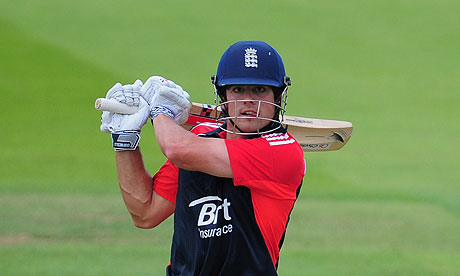
Alastair Cook England Sri LankaAway from the glare of the series-sealing 16-run defeat of Sri Lanka at Old Trafford on Saturday, Andy Flower must have been tempted, just for a moment, to have a private little gloat at a job well done. This latest four-yearly restyling of England's one-day international team has centred around a number of small but significant judgment calls made by the England coach. Most of which – as of around 6.30pm on Saturday when a sun-drenched, hospitality-flushed Old Trafford crowd acclaimed Jade Dernbach's decisive two-wicket burst – seem to have come good at just the right moment.

First came the elevation of Alastair Cook from a player deemed not worthy of inclusion in the World Cup squad to dashing opener and captain. Five matches into the Cook era player and coach will be delighted, and maybe even privately a little surprised, by the abruptness of Cook's reinvention: firstly as man of the series with 298 runs at 74.5 and – get this – a Sehwag-ish strike rate of 96.75, and also by Cook's impressive command of his team in the field, climaxing in a perspiration‑free marshalling of the tight finish on Saturday.

"He had some tricky decisions to make throughout the series, and he was under pressure from a number of quarters," Flower said, referring to unfavourable pre-series media scrutiny. "He handled that pressure really well, and made some really good decisions out there today. He had to be very flexible, and he was."

So far, so good for Cook. But with England due to start a Test series against India in 10 days' time, the challenge he faces is no longer to expand his game in powerplay cricket but instead contracting it sufficiently to retreat back into the pared- down style that has served him so well in the longer game. Flower is adamant there was no gamble involved in asking Cook to make the adjustment.

"We don't think that we're gambling. We make decisions based on what we believe is best for English cricket. His performance out there is to do with winning games for England, and he's good enough to focus on that.

"Graham Gooch has worked very closely with him [Cook] on his batting for a long time because obviously one-day cricket is very different to Test cricket. I think he's adapted well. It might not look as pretty as a Jayawardene, but it's been even more effective during this series."

There have been other successes. The series was effectively sealed by Dernbach's dismissal of Angelo Mathews with his famed slower ball – a moment of happy synchronicity for a bowler picked ahead of Stuart Broad in an uncharacteristically ruthless selection call.

"He [Broad] was left out of the side because we wanted to bring a spinner in, and we thought that Dernbach would be more effective in these conditions," Flower said. "Broad's been a superb performer for us, a great competitor – and I foresee him doing great things for us in the future both in this upcoming Test series and the one-day series."

Broad will now play in Nottinghamshire's four-day game starting on Monday, which will presumably form part of an extended audition for a place in the team at Lord's to face Test cricket's champion nation.

It is a series England have been building towards since before the winter Ashes tour. With this in mind there is perhaps reason to feel a degree of disquiet over the wellbeing of Ian Bell, a colossus in Test cricket of late but an increasingly fretful figure in the 50‑over game where he is clearly uneasy at No6.

At Old Trafford Bell walked off in a state of some exasperation after an ugly, un‑Bell‑like innings spent trying to muscle the ball around in the closing overs. Flower gave predictably short shrift to the notion Bell might be being mishandled.

"Ian Bell's job, or anyone else's job when they're picked for England, is to perform. Whether they're happy or not is by the by. They are given a job, and they have got to do it. He's had a tough series. He wasn't the only one – not everyone can succeed at the same time."

For the coach the message is entirely positive, understandably so for a man whose judgment has been once again quietly vindicated. "The bottom line is we did it, we didn't lose the series – and it's a good confidence-builder for those guys that held themselves so well under pressure."
Enhanced by Zemanta

Swann and Anderson the key bowlers for England: Dravid

England cricketer James AndersonImage via WikipediaLondon, July 12 (IANS) India's middle-order batsman Rahul Dravid picked off-spinner Graeme Swann and pace spearhead James Anderson as the key bowlers for England in the eagerly-awaited cricket Test series beginning at Lord's next week.

'James Anderson has bowled really well. He's been the trump card. Obviously Graeme Swann is a top-class spinner. We first saw him in England bowling here last time and the boys rated him. He's come on leaps and bounds from then and has become one of their lead bowlers. Swann and Anderson are the key,' Dravid was quoted as saying by The Cricketer.

Dravid, who averages over 65 in Tests in England, said Indian batsmen will look to be positive against Swann.

'He's an attacking bowler and that's one of the things that is different. He's not just looking to contain, he's looking to take wickets. He's not scared to toss the ball up and gets turn with good sideways spin. It will be a good contest against batsmen who are good players against spin, who will not be scared to take him on.'

With India the top-ranked Test team in world cricket and England (3) keen to take over their mantle, Dravid recognises the significance of the forthcoming series.

'All series are important series. But this one is important because it's a series between two teams that have had good recent records, which gives it a bit more context. We won in England last time, so from that point of view England will want to do better this time', he said.

For India to repeat their series win of four years ago, Dravid says the fitness of their fast bowlers, led by Zaheer Khan and the resurgent Ishant Sharma, will be critical.

'It's a hard one to call. England are playing at home, so they have that advantage. We're a good side, a settled side, and we've been playing good cricket over the last couple of years. If we can keep our fast bowlers fit, then we'll be very competitive,' he said.

Looking back over his 15 years as a Test player, Dravid said the highlight has been India's growth to become the world's best Test team.

'I'm really proud that India is the No.1 Test team. I've seen Indian cricket since 1996 and to be part of this journey and to see India become the No.1 Test team - not just for a short period of time because we've now been there for more than a year - it's something I'm very proud of,' he said.
Enhanced by Zemanta

Team India's tales of missed opportunity

Sourav Ganguly takes a shot - the ball is goin...Image via WikipediaUnwilling to risk their 1-0 in the series, India opted to call off the third Test by mutual agreement while needing 86 to win from 15 overs, after having been set a target of 180 in 47 overs. Here are some similar, debatable instances when India seemed happy with a draw instead of going for a win...

Second Test vs West Indies, Barbados, Current (2011) series:

A dramatic draw saw India end three wickets short of what would have been a 2-0 series lead. Set 281 to win from 83 overs, the West Indies played for a draw and Bravo, Baugh and Chandepaul thwarted India. MS Dhoni deserves credit for a sporty declaration on the final day which brought the Test alive when close to 128 overs were lost due to bad weather. But the questions remain: Did India bat too slowly on the crucial fourth day, adding just 206 runs in 83.2 overs?

Third Test vs New Zealand, Ahmedabad 1999:

Under Sachin Tendulkar's captaincy, India did not ask New Zealand to follow on even after a 275-run first-innings lead. First, India declared at 583 - courtesy a double ton from Tendulkar and centuries from Sourav Ganguly and S Ramesh, following which the Kiwis responded with a slow but gritty 308. Three and a half days had gone by and Tendulkar opted to rest his bowlers instead of forcing the Kiwis to bat again. India batted for another 32 overs and lost the chance to press for victory.

Fourth Test vs Australia, Sydney 2004:

A big missed opportunity, this time from Sourav Ganguly, who did not press for a series win by refusing to ask the Aussies to follow on. Batting first, India notched up a mammoth 705/7 declared courtesy Tendulkar's unbeaten 241 and Laxman's 178. The Aussies managed 474 in reply, but instead of asking them to bat again India opted to consolidate their lead, batting for again another 43.2 overs. Set to bat out a day, Australia saw Steve Waugh - playing his farewell Test - and Simon Katich thwart the Indians with gritty knocks.

Third Test vs England, The Oval 2007:

Under Rahul Dravid, India seemed content with a 1-0 series lead and did not push for victory in the third Test on a featherbed at the Oval. Again, they did not ask their opponents to follow on. A 664-run first-innings cushion wasn't enough to convince the Indians to ask England to bat again after they replied with 345. In their second innings, India batted so slowly that infuriated fans started yelling in the stands. The skipper scored only 12 off 96 balls. Set 500 for victory, England lost six wickets before securing the draw.

Second Test vs Australia, Melbourne 1986:

Lack of urgency cost India what could have been a famous win. Chasing 126 and with most of the post lunch play onwards on the last day to bat, India scored at 2.36 per over before bad weather intervened. India finished at 59/2 on a turning track in which they had dominated from Day 1, restricting the Aussies to 262 and then responding with 445. Some bad umpiring and India's unwillingness to attack then saw Australia go from 231/9 to 308 in their second essay, with Border scoring 163. Still, they could have won when they came out to bat last.
Enhanced by Zemanta

Sammy surprised at India's decision

DOMINICA: Darren Sammy's tenure as West Indies skipper has ended with the India series and now it is up to the selectors to decide if he should continue further. However, the smile on his face, which had faded after his team's poor performances, is beginning to reappear.

On Sunday evening, he was sporting a huge grin after VVS Laxman and Rahul Dravid opted to offer a draw and shake hands. He was happy with the result as much as he was surprised by India's decision to call off play. "With 15 overs to go and 86 runs required, and considering the calibre of players they have like Dhoni and guys who can hit the ball, I thought they would it give it a go, being one-up," Sammy said after the match. "But I guess with my ploy to have Bishoo bowl in the rough, they didn't fancy their chances of going after him. I am quite happy with the result."

West Indies kept a negative line, down the leg side, which made scoring difficult. While it may be argued that it was against the spirit of the game, it was well within the rules. "We showed a lot of character. One of our main bowlers ( Ravi Rampaul) was down but we stuck at it. And the batting came good in the very last innings of the series. It helped us salvage a draw. So well done to the team," the skipper said. When asked if India didn't show enough respect towards the crowd that had come here expecting a result, Sammy said "As you saw, the crowd, who are very understanding, treated the drawn result as a win for us because we got out there and fought.

"My back is broad. I will still come out smiling. You can't please everyone. The best man who walked the face of the earth never did anything wrong, but he was still crucified. And I am nowhere close to that," he said.
Enhanced by Zemanta

Dominica draw rankles Harbhajan Singh

Harbhajan Singh - Ind Vs Eng,Mumbai, March 29,...Image via WikipediaROSEAU, ( DOMINICA): Indian skipper Mahendra Singh Dhoni might be content with it but off-spinner Harbhajan Singh finds it incomprehensible that West Indies managed to force a draw in the third and final Test.

"I took four but could have had six or seven. That's fate," rued Harbhajan even as the two centurions, Kirk Edwards and Shivnarine Chanderpaul, acknowledged the perennial threat the off-spinner posed on a flat track.

Chanderpaul was twice dropped by Rahul Dravid in the slips and at least thrice Edwards popped chances to which the close-in cordon reacted late. India drew the final Test after deciding to abandon what looked like an exciting chase despite having seven wickets in hand to take the series 1-0

A little luck would have been in complete conformity with Harbhajan's rising graph on foreign pitches. Starting 2009, Harbhajan took 16 wickets from three Tests in New Zealand with the best of 6-63 in Hamilton and an average of 21.38.

Last year, he had 7 for 120 at Newlands against a formidable South African batting line-up. In all, he finished with 15 wickets at 29.60 from three Tests.

For all his criticism in the Caribbean, his figures of 11 wickets at 25.36 in a seamer-dominated series isn't bad. For critics, it's his average of 37.40 plus in 44 Tests for a haul of 146 wickets on foreign pitches which proves he is only good on helpful Indian pitches.

"It's a strange logic, on one hand you blame our batsmen for thriving on flat sub-continent pitches. Yet, when I take wickets on those very flat pitches, nobody credits me," said Harbhajan.

It's the same argument with which critics slammed Anil Kumble before the 2004 trip to Australia changed the perception. He too was deemed to flourish only on sub-continental pitches and nobody was yet willing to term him great before he started picking up wickets regularly abroad.

"I too have succumbed to this constant nonsense. I tried to bowl this classical loop, flighting it on the off-stump and trying to open up that gap between the bat and pad of a right-hander.

"It was in the Centurion Test of the last series against South Africa. Batsmen could slog-sweep without worrying on LBW since their front foot was outside the off-stump. Even the off-side field was easily manipulated. Jacques Kallis got a double century. Hashim Amla could score at will.

"I am thankful to what Ravi (Shastri) bhai then advised me. He asked me to look to bowl at the off-stump or the fourth stump, keep a widish mid-off and midwicket. If the batsmen tried to push it between bowler and mid-off, he could offer a return catch. If he tried to lap it on the onside, there was midwicket. The entire field could move with the batsman.

"It worked brilliantly. I got 7 for 120 in the next Test. Amla, in both the remaining Tests."

Not easily remembered is his 4 for 10 from seven-odd overs in the Durban Test. It gave India levers of advantage in the game even after scoring 205 in the first innings. They ended up winning the Test.

"Classical spinners operated in eras when batsmen were not scooping, slogging or reverse sweeping. Today, hitting over the top is a norm. Bats are so much meatier. Teams don't make 200 runs in a day any longer.

"Another factor no longer remembered is that visiting batsmen are not afraid of spin in the sub-continent. They travel so much to our part of the world, be it as a member of the A teams; the ever-increasing number of series; the exposure in IPL. They are getting better at handling spin all the time."

Harbhajan concedes he could have got his 400 wickets in 85-86 Tests but for the two "black" years in 2006 and 2007 under the stewardship of Australian coach Greg Chappell.

"Those two years were terrible. I was never ever comfortable. You were made to feel you were no good; you constantly felt under surveillance."

For records sake, Harbhajan picked up 49 wickets from 14 Tests while Chappell was turning heat on his purge programs. It was much below his career average of four wickets per Test.

The spotlight is now firmly on the India-England series, starting in just over a week's time with the first Test at Lord's, the 2000th Test overall and the 100th between the two nations.

There is also a hyped up confrontation between Harbhajan and Graeme Swann for their different yet highly successful bowling styles.

"I find it strange that it's me who has to prove against all new off-spinners when it should be the other way around. If lasting 13 years in international cricket was that easy, you would have had dozens and not a mere four spinners in the 400-plus list.

"Having said that, it would of interest to me to see how Swann turns up against our batting greats."

And how he himself would bowl to the likes of Sachin Tendulkar, Rahul Dravid and VVS Laxman?

"They all are different. Against Sachin, I would like to plug his run-scoring areas - the whip through onside; the paddle sweep, the late cut he imparts against full pitched deliveries. Fields for Dravid and Laxman would also be different."

Harbhajan then casts his mind at the England venues where four Tests between the two teams would be played, starting July 21.

"Lord's can be flat; and so could be Oval. The latter, if it helps spinners, could be a difficult venue for the batters because of the bounce in the pitch. Nottingham usually provides early nip. It could have something for the bowlers even on the last day. I haven't played a Test in Edgbaston (Birmingham) yet."

India have lost four of their five Tests in Edgbaston. However, they have won a Test each at Lord's, Oval and Trent Bridge. Headingley is the only venue where India has won twice - in 1986 and 2002.
Enhanced by Zemanta

Team India slammed for playing it safe

Mahendra Singh Dhoni at Adelaide OvalImage via WikipediaNEW DELHI: Indian media on Tuesday lashed out at skipper Mahendra Singh Dhoni for not going for the kill in the third and final Test against the West Indies, which ended in a tame draw.

Chasing 180 for victory, India were 94/3 when they decided to bring the match to a close with a possible 15 overs left to play on Sunday, the last day of the inaugural Test at Windsor Park.

"At least an effort from Dhoni's men - especially given the Twenty20 era in which these batsmen continue to prosper - would have been worthwhile, but certainly not a lame draw," said the Times of India.

"Dhoni, though, is yet to lose a series in 25 Tests as captain. However, a bit of aggression would have added a few more stars to his captaincy credits."

The Hindustan Times said there was "disbelief and shock" in the end as the world number one Test team decided not to attempt the run-a-ball chase.

"The euphoria of Dhoni leading a depleted team to India's second series win in a row in the West Indies vanished as debate raged on why India were timid," said the paper.

"But it was astounding to see no attempt being made to get closer to the target when it would have been brilliant to make a statement, or at least send the right message."

India needed 86 more runs in the last 15 overs with seven wickets in hand before settling for a draw and a 1-0 series win.

"It was surprising why India did not, at least, attempt to wrap up the series 2-0 when it had big hitters Dhoni and Harbhajan Singh left," said the Hindu newspaper.

"Dominant teams play to win and are ruthless when they have the adversary down. India did not display the heart of the world number one in Tests."

Even West Indies skipper Darren Sammy said he was surprised by India's decision.

"I think if 15 overs were left and 86 to get and the calibre of players they have, Dhoni and the other guys who can hit the ball, I thought they would give it a go, being 1-0 up (in the series)," he said after the match.

Dhoni and coach Duncan Fletcher, however, defended the decision.

"I am not disappointed about stopping the run chase. We were risking a series win going after the target. We realised that it was not worth going for it after those wickets," said Dhoni.

"We gave it a go, but we are happy with the series win."

Fletcher said it was not easy scoring runs on a difficult pitch.

"You think we haven't made a statement. We have won the T20, ODI and Test series. That in itself is a statement," said Fletcher.

India now tour England for a four-Test series, starting at Lord's on July 21.
Enhanced by Zemanta

Friday, 8 July 2011

The Sport of Motocross

A Yamaha 450 cc four-stroke on display at the ...Image via Wikipedia

One of the most popular motorcycling sports of all times, motocross started as a kind of all-terrain racing event that took place on off-road circuits, muddy, hilly, slushy or rocky routes and sharp turns. The sport had its origin in the early part of the twentieth century in Great Britain. It was then famous as ‘Scrambles’ and slowly gained popularity among many European nations in the 1920s and 30s. Motocross was the term that came later and was derived from the combination of the French word motocyclette meaning motorcycle and ‘cross-country’.

Since the first off-road event in 1924 in Camberly, Surrey motocross has become quite a rage with motorcycling fanatics and this fad continues till date. Motocross racing comprises forty riders who compete on a particular track simultaneously. Usually, a professional race lasts for at least half an hour. However, amateur motocross races are usually only thirty minutes long.

The machines used in motocross racing are lighter than regular motorcycles. While motocross championships in the 1950s started with 500cc engines, 250cc engines were introduced in 1957, and the even lighter 125cc category in 1975.

The sport of motocross requires extreme grit and physical fitness of the rider. Add to that the thirst for adventure, and you have the perfect motorcycling enthusiast. Racing on uneven surfaces that could entail high jumps and heavy bumps is not everyone’s cup of tea. A motocross rider, therefore, must be willing to face the worst case scenario if he or she wants to race and compete.

Since such perils lie ahead of the rider, the gear that he or she must wear is of critical importance. Protective helmet, boots, pants, jersey, knee guards, gloves, chest protectors, and sunglasses form the attire of a motocross rider.

A race of motocross generally comprises 2 “motos”, each being five to eight laps long. The count of each rider in each moto helps determine the winner. The rider to reach the finish line first scores the highest number of points.

Technology has also had strong influence on the sport of motocross. Advances in motorcycling techniques and engines have enhanced racing and the machines being used. While motocross racing began with four-stroke engines, two-stroke ones finally paved the way for more powerful and efficient racing bikes to enter the motocross scenario. Along the years, even more enhanced features such as water-cooling systems and mono-shock absorbers were added, giving motocross an even greater thrust.

The sport of motocross gained popularity across Europe, where it had originated, during the 1950s. In the decades to follow it crossed international waters and became one of the best-loved motorcycling sports in the United States as well. Australia and New Zealand are the other countries where motocross is a rage among motorcycling enthusiasts of all ages.

This transformation in the sport’s history was also marked by the shift in Belgian, British, Swedish and Czechoslovakian dominance to American positions at the races. Another significant advance in motocross world was the entry of Japanese motorcycle manufacturers into a sphere ruled by European companies so far. All these transformations and enhancements in motocross history have been instrumental in creating a sport that is international in stature and wildly loved throughout the world.

Chitika

Share

Twitter Delicious Facebook Digg Stumbleupon Favorites